
Who makes Tensela
I am Victor Crespo, an architect and a designer who specialises in digital products, and I love parametric design. Tensela is a personal project: I develop it with artificial intelligence as my development team.
Where the idea comes from
Section titled “Where the idea comes from”Since 2007 I have been trying to work as an architect on Linux. At first it was very hard: there was almost nothing for our trade. Inkscape was in its first versions and Blender was not what it is today. I have worked on Linux ever since: I started with Ubuntu, and today I move between Ubuntu and Debian. I like how it is thought out, how folders and packages are ordered, and the community around it.
I say this without zeal: Linux does not solve everything. The big design programs, those of Adobe and Autodesk, were and still are very good. Nearly all of them run on Windows, many also on Mac, and they need a powerful machine. Architects and designers who work professionally on Linux are still few.
What I love most is parametric design: visual algorithms, the idea that an algorithm is a recipe, a series of steps you can change to get another result. I wanted to do it on Linux, and I could not:
- Rhino, which I use, only ran on Linux inside a virtual machine with Windows, with almost no graphics acceleration.
- Dynamo was made to be used with Revit, which does not run on Linux.
- Grasshopper is a great program, but I got lost in it: for what I wanted, I struggled to find the way. The same happened to me with Blender’s nodes for architecture.
For me, it was very hard to move forward with those tools. And for an architect a facade, a structure or a form is not an abstract number: it has a height, a thickness, a geometry. Something thought out that way was missing, and something that ran on Linux.
An idea that comes from books
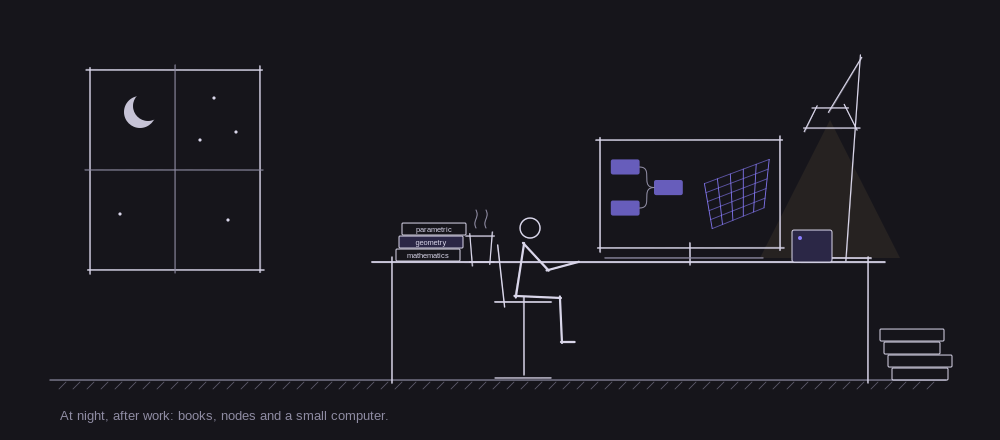
Section titled “An idea that comes from books”The idea of Tensela was not born with artificial intelligence. It started long before, when it did not exist or I had no access to it: in books. I am a reader, and I still keep many, on architecture, on parametric design and on mathematics. Tensela was tested with exercises of its own, born from what I learned in books more than ten years old, written when there were no AI assistants. Architecture has a lot of mathematics in it, and I like mathematics.
Behind it there are years of experience: what I read, what I tried, what I learned along the way. I still have a lot to learn.
Artificial intelligence does not do it all by itself. It helps to build what you already understand, and what you are willing to check again and again.
How it was made
Section titled “How it was made”I am not a programmer: my programming knowledge is basic, not enough to do this alone. Artificial intelligence opened that door for me, and I used it as a development team.
I know that many new programs made with AI are appearing today, and that it is easy to think this is one more. So I say it plainly: Tensela did not come out of a single request. It is months of iteration: testing each node with real exercises of facades, roofs, structures and fabrication, checking the result, correcting it and testing again. The mathematical base (the surfaces, the form finding, the sun, the optimisation) was built and checked step by step. Every stumble along the way became a change in the program or a tip in this manual.
It is many early mornings, nights and weekends, outside my office job and my time with my family. My own time and money went into it, without big resources.
Tensela was born for Linux because that is what was missing. Later I want to bring it to Windows and macOS, when there are resources to do it well.
Small on purpose
Section titled “Small on purpose”Next to great programs such as Rhino and Grasshopper, Dynamo or Blender’s nodes, Tensela is very small. And partly it is small on purpose: it is meant as the synthesis we look for in architecture, what is really needed.
It is like a camera full of options, or a device with hundreds of buttons: we hardly ever use everything. Tensela prefers fewer nodes that are well understood.
What I think is worth something is the way of thinking it offers: each step is a node you can understand, lists have names, and what you draw has the measures of architecture. If that way of thinking helps you, even if you later take it to another program, Tensela has done its job. It will grow, without losing that.
The story of how Tensela was designed is told as a case study on 3dvic.com.
Support Tensela
Section titled “Support Tensela”Tensela takes many hours of work, and more are coming: new nodes, recipes, videos. If it helps you in your work or your studies, you can support it with a donation.