
NURBS curves and surfaces
A NURBS is a smooth curve or surface defined by a few numbers. It is the usual way to describe free shapes precisely: a handrail, the edge of a slab, a shell.
Control points
Section titled “Control points”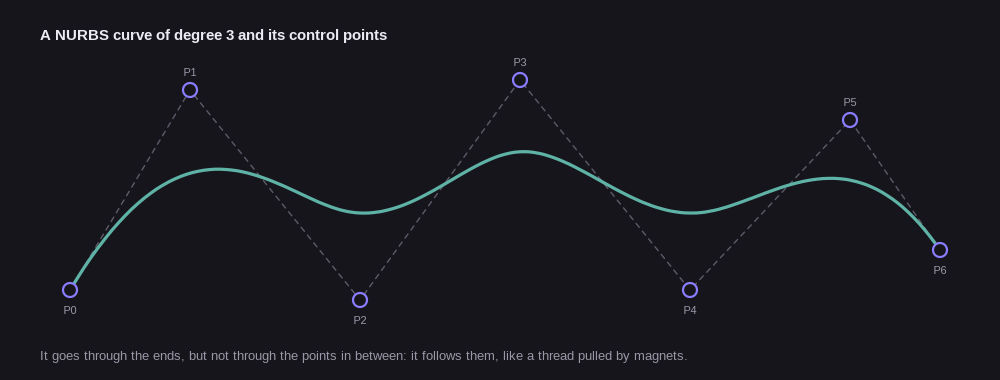
The curve does not pass through its control points (only, usually, through the first and the last): they pull it like magnets. This is the difference with Curve through points, which passes through every point. The polygon of the control points is a good guide to the shape: the curve follows it, smoothed.
Degree
Section titled “Degree”How smooth and how taut the curve is: 1 is the control polygon itself, 2 makes arcs, 3 is the usual smooth
curve, and higher is tauter. A curve needs at least one more control point than its degree.
Weights
Section titled “Weights”How strongly each control point pulls. What counts is the difference between them: all at 2 is the same as all at
1. With the right weights, a NURBS draws an exact circle, which a plain polynomial curve cannot.
How the curve is spread between its control points: evenly, by distance, or by hand. Repeating a knot makes a kink. You only need them to fine-tune a curve.
Surfaces: u and v
Section titled “Surfaces: u and v”A NURBS surface is the same in two directions: a grid of control points, rows by columns, with a degree in each
direction. Its two directions are u (along the rows) and v (along the columns), each from 0 to 1. Every
point of the surface has its u and v, which is how nodes ask for a point at the middle or the curves along u.
Judging a curve
Section titled “Judging a curve”The curvature comb shows whether a curve is good: smooth tips mean a smooth curve; a jump, an abrupt change; a spike, a corner.