
Visual algorithms
An algorithm is a recipe
Section titled “An algorithm is a recipe”An algorithm is a list of steps that, followed in order, always gives a result: a recipe. It does not need a computer. Take a rectangle of 20 × 12 m, divide it into panels of 1 m, put a sun fin on the centre of each panel is already an algorithm.
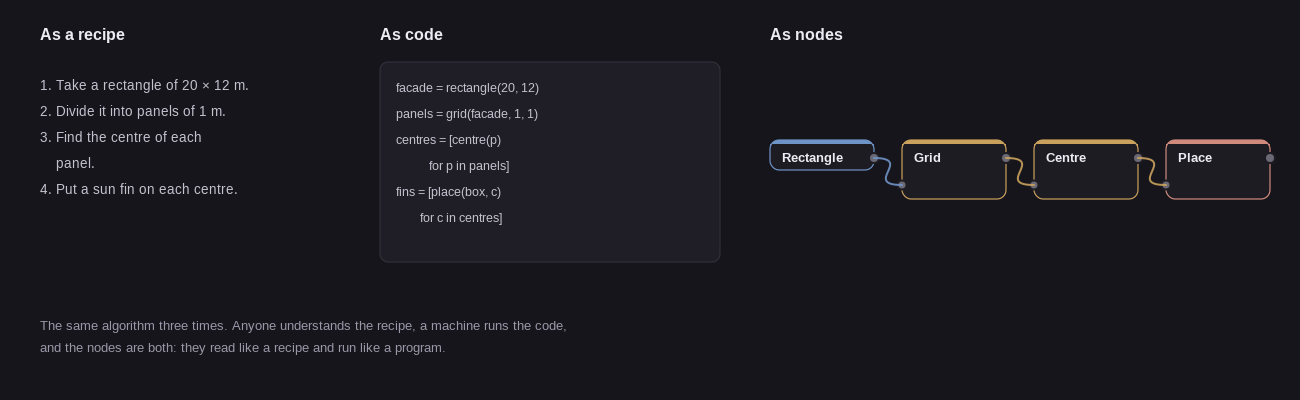
The same recipe can be written in three ways. In words, anyone understands it but no machine runs it. In code, a machine runs it but you need to learn a language to read it. A visual algorithm draws it as nodes and cables: it reads like the recipe and runs like the code.
What a visual algorithm is
Section titled “What a visual algorithm is”A visual algorithm is a graph: a set of nodes joined by cables.
- A node is a function: it receives some inputs and gives one result. A Grid receives a rectangle and two sizes, and gives panels. It always gives the same result for the same inputs.
- A cable is data: it carries the result of one node to an input of another.
- The data flow one way. From the values you type, through the nodes, to the form. That is why the graph reads from left to right.
- There are no loops. A node cannot depend on its own result: Tensela refuses the cable that would close a circle, and says why. This is what makes the graph always give an answer, and what lets Tensela know exactly what to recalculate when something changes (How a project is calculated).
Repeating without loops
Section titled “Repeating without loops”If there are no loops, how do you repeat a step 240 times? You do not: you give the step a list of 240, and it works on all of them at once. This is what lists with names are for.
When a step really has to work on its own result (a fractal, a curve that subdivides, a growth), a group can repeat itself a number of times: the loop is closed inside one card, with a count, so it always ends.
What makes it parametric
Section titled “What makes it parametric”Parametric does not mean curved or complicated. It means that the design is described by its parameters (the width, the number of floors, the angle) and by the dependencies between its parts: the panels depend on the facade, the fins on the panels. Change a parameter and everything that depends on it follows.
The value is not in one form but in the family of forms the recipe can give: the same project makes a facade of 12 m or of 40 m, open or closed, and you choose among them by looking.
Where it comes from
Section titled “Where it comes from”Designing with rules is much older than computers.
- Antoni Gaudí found the form of his vaults by hanging chains with weights and turning the model upside down: the form came out of gravity, not of a drawing. The node Equilibrium does the same thing.
- Frei Otto studied soap films and hanging nets to find the forms of his tensile roofs, such as the Munich Olympic Stadium.
- Luigi Moretti, in Italy, spoke of parametric architecture in the middle of the 20th century, with studies of stadiums whose form came from parameters such as the view from each seat.
- Ivan Sutherland’s Sketchpad, in 1963, was one of the first programs to draw with rules: lines that stay parallel, points that stay joined.
- In the late 2000s, visual programming reached architects, with tools such as Grasshopper and, later, Dynamo. Tensela comes from that tradition, and aims at a gentle learning curve.
The mathematics behind
Section titled “The mathematics behind”Each family of nodes rests on a piece of geometry. You do not need it to design, but it helps to know where things come from:
- Coordinates and vectors: every point is three numbers, every direction an arrow. Units and directions.
- Curves and surfaces: control points that pull a smooth form. NURBS.
- Curvature: why some surfaces can be built with flat sheets and others cannot. Curvature.
- Meshes: forms made of flat faces, the language of fabrication and simulation. Meshes.
- Forces and optimisation: forms that find themselves, and the best value among many. Form finding.