
Named lists, inside
This page is for whoever wants to know how lists with names work inside, with some
code. You do not need it to design. The code is Python, simplified from the source of Tensela (the file data.py).
What a value is
Section titled “What a value is”Every value in Tensela, from a single number to the corners of a thousand panels, is a Data: a block of numbers (a numpy array) and the names of its first directions, its levels.
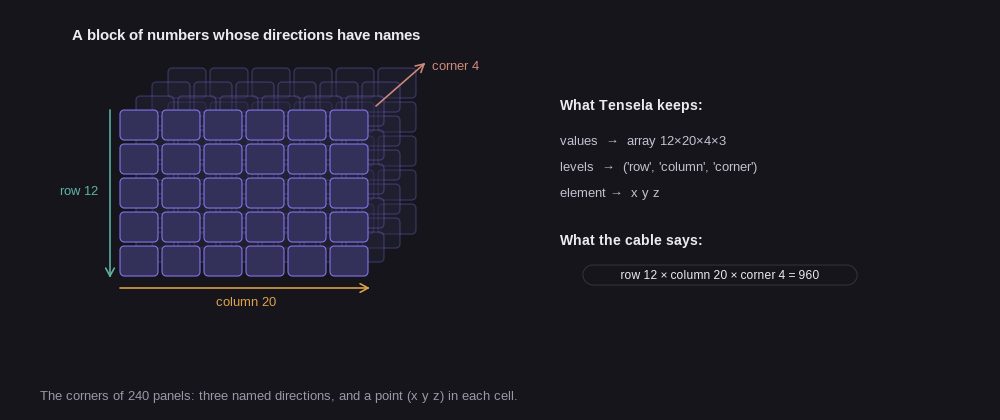
centres = Data(values,                    # a numpy array of 12 × 20 × 3               levels=("row", "column"),  # the names of the first two directions               name="centres")
centres.sizes   # {"row": 12, "column": 20}centres.shape   # "row 12 × column 20 = 240"   (what the cable says)
The directions after the levels describe each element: a number has none, a point has one of size 3 (x y z), a rectangle has its four corners. So the block of 240 centres is 12 × 20 × 3, but only row and column are lists.
The one rule
Section titled “The one rule”Every node that combines inputs goes through the same function, align. It has three steps:
- The result has all the levels of the inputs, in the order they appear.
- A level that is in two inputs must have the same size in both; it pairs one with one. If the sizes differ, Tensela stops with a notice instead of guessing.
- A level that is in only one input crosses with all the others.
def align(*inputs): levels, sizes = [], {} for data in inputs: for level, size in data.sizes.items(): if level not in sizes: # a new level: it goes into the result levels.append(level) sizes[level] = size elif sizes[level] != size: # the same name, another size: a clear notice raise ShapeError(f"The sizes of “{level}” do not match: …") return levels, [extend(d, levels, sizes) for d in inputs]extend puts each block in all the directions of the result. It turns the block to the order of the result, gives
it size 1 in the levels it does not have, and stretches it to the full size. The stretching is numpy’s
broadcasting: no number is copied, the block is only read as if it were bigger.
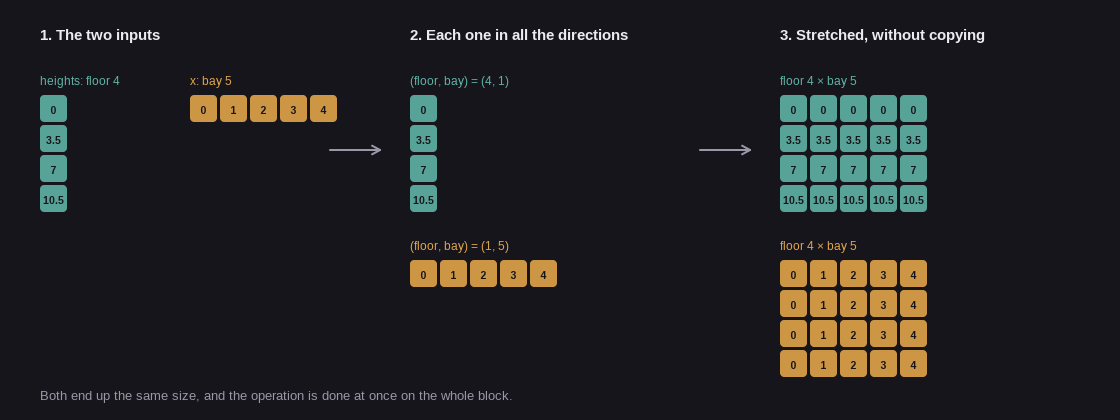
def extend(data, levels, sizes): order = sorted(range(len(data.levels)), key=lambda axis: levels.index(data.levels[axis])) block = numpy.transpose(data.values, order + element_axes) block = block.reshape([data.sizes.get(n, 1) for n in levels] + element_shape) return numpy.broadcast_to(block, [sizes[n] for n in levels] + element_shape)With the inputs aligned, a node is written once, for whole blocks, and works the same for one element or for 24 000:
>>> heights = Data([0, 3.5, 7, 10.5], levels=("floor",), name="heights")>>> x = Data([0, 1, 2, 3, 4], levels=("bay",), name="x")>>> points = apply(make_point, x, heights) # different names: they cross>>> points.shape'floor 4 × bay 5 = 20'>>> shift = Data([0, 0.2, 0.4, 0.6], levels=("floor",), name="shift")>>> apply(add, heights, shift).shape # the same name: one with one'floor 4'>>> apply(add, heights, Data(range(5), levels=("floor",), name="five"))ShapeError: The sizes of “floor” do not match: 4 in “heights”, 5 in “five”.Working on one level, by its name
Section titled “Working on one level, by its name”Because levels have names, an operation can say which level it works on without counting positions:
reduce(areas, "sum", along="panel") # the area of each floor: the panels are added upreorder(points, "floor", mode="invert") # the floors upside down; the bays as they wereSummarise, Reorder, Filter, Pick and Split all ask for a level by name. There is no transpose:
floor × bay and bay × floor are the same block, because the order of the levels never decides anything.
Lists that are not rectangular
Section titled “Lists that are not rectangular”Real projects are not always regular blocks:
- Levels of variable size. A tower with more panels at the bottom than at the top: the level panel has a different size on each floor. Tensela keeps the block padded to the largest size, the count of panels of each floor, and a mask that says which cells really exist. The nodes only read the cells that exist.
- Holes. By default, Filter does not remove elements: it leaves them empty in their place, so the grid still reads the same (the panel of row 3, column 7 is still there, or is an empty place). With remove: yes, the ones that stay are numbered again.
- Numbering. The elements of a level are numbered from 0, unless the level starts at another number: with two basements, the floors go from −2.
A safety net
Section titled “A safety net”Before calculating, align multiplies the sizes of the result. Above 5 million elements it stops with a notice
instead of freezing the computer: it is almost always two levels crossing that should have been paired (the same
name), or one digit too many.
Why “tensor”
Section titled “Why “tensor””A block of numbers with several directions is what mathematics calls a tensor. Most programs number its directions (axis 0, axis 1, axis 2). Tensela names them. That small change is what removes the need to arrange data by hand, and it is where the name Tensela comes from: How Tensela thinks.