Surfaces
Surfaces are roofs, walls, shells, skins and slabs. They are petrol blue on the canvas.
On a surface, a position is u and v. A surface has two directions, like the rows and columns of a sheet: u
along the rows and v along the columns, each from 0 (one edge) to 1 (the other). u 0.5, v 0.5 is the middle.
Make a surface
Section titled “Make a surface”
What for. To close a closed curve with a surface: a roof, a free-form slab, a slab with a courtyard.
| Input | What it means |
|---|---|
| curve | the closed outline |
| holes | optional: closed curves inside it (a courtyard, a skylight) |
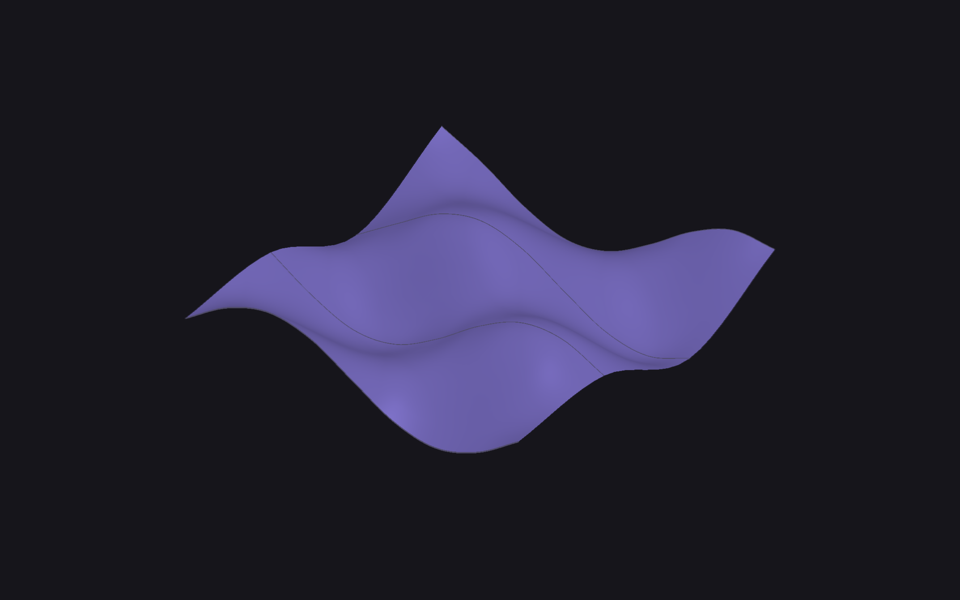
What for. A surface through several curves in order: a wavy wall through three profiles, a roof through its sections.
| Input | What it means |
|---|---|
| curves | the sections, in a list |
| along | the level of the sections; empty: the last |
| smooth | yes: smooth through the sections · no: straight between them |
| closed | yes: the last section goes back to the first |
Tips.
- If it comes out twisted, some curves go the other way: put a Flip curve with a direction before it.
Extrude
Section titled “Extrude”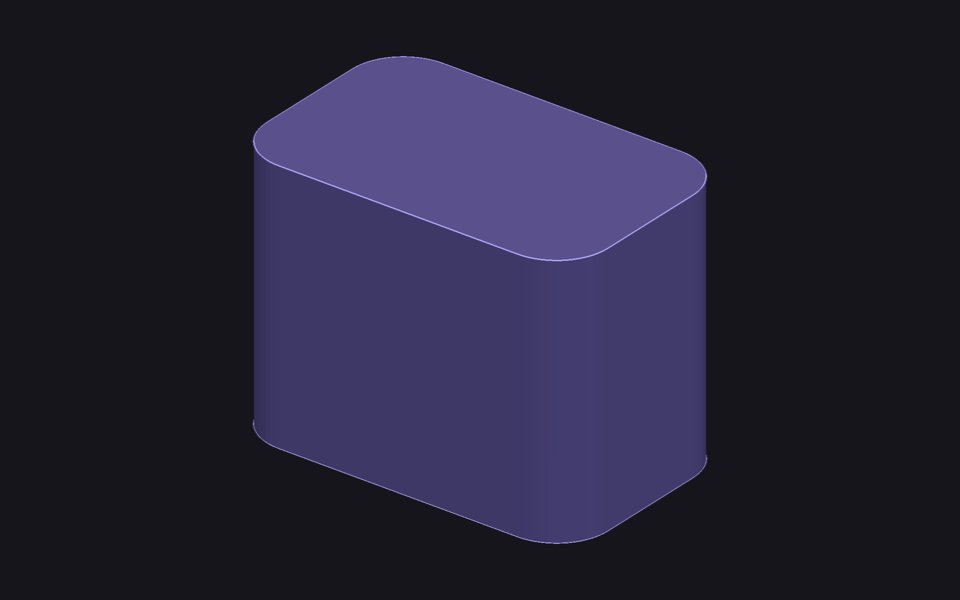
What for. To drag curves into a sheet or a wall; with caps, a closed plan becomes a volume. Or to bring them to a point: a pyramid, a cone, a hip roof.
| Input | What it means |
|---|---|
| mode | vector: dragged · to a point: meets at an apex |
| vector | which way and how far; 1 m up by default |
| point | the apex (to a point) |
| caps | yes: a closed curve gives a closed body |
Surface from points
Section titled “Surface from points”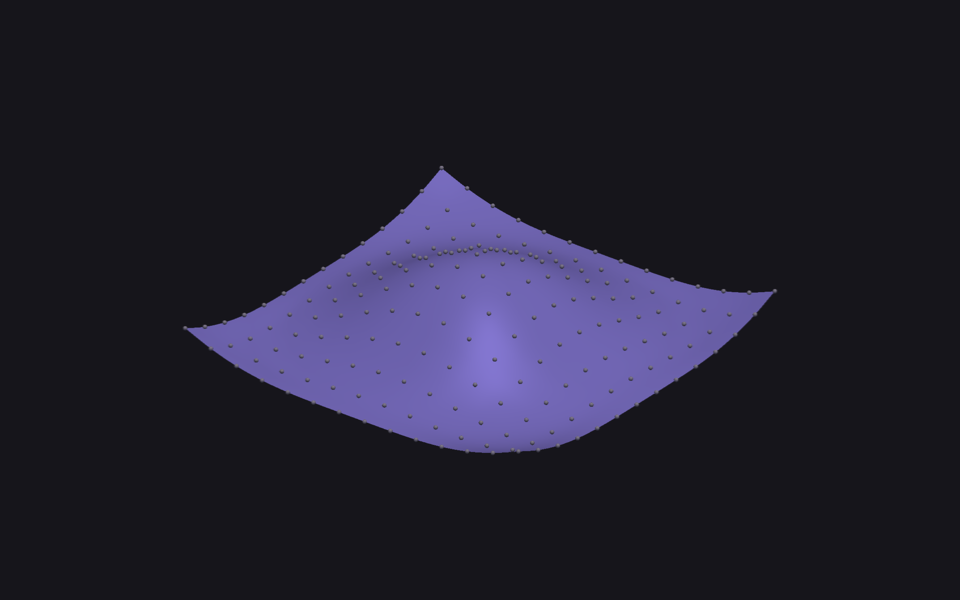
What for. A surface through points: a grid of points (rows × columns), or a loose cloud like the points of a land survey.
| Input | What it means |
|---|---|
| points | in a grid (two levels) or loose |
| mode | grid or cloud (joined in triangles) |
| smooth | yes: curved between the points · no: flat facets |
Tips.
- A cloud gives flat triangles, which is right for a survey: between two measured heights nothing more is known. With smooth, each triangle curves, still passing exactly through every height.
- Shapes with sharp edges show small steps when smooth: use more points, or turn smooth off.
NURBS Surface
Section titled “NURBS Surface”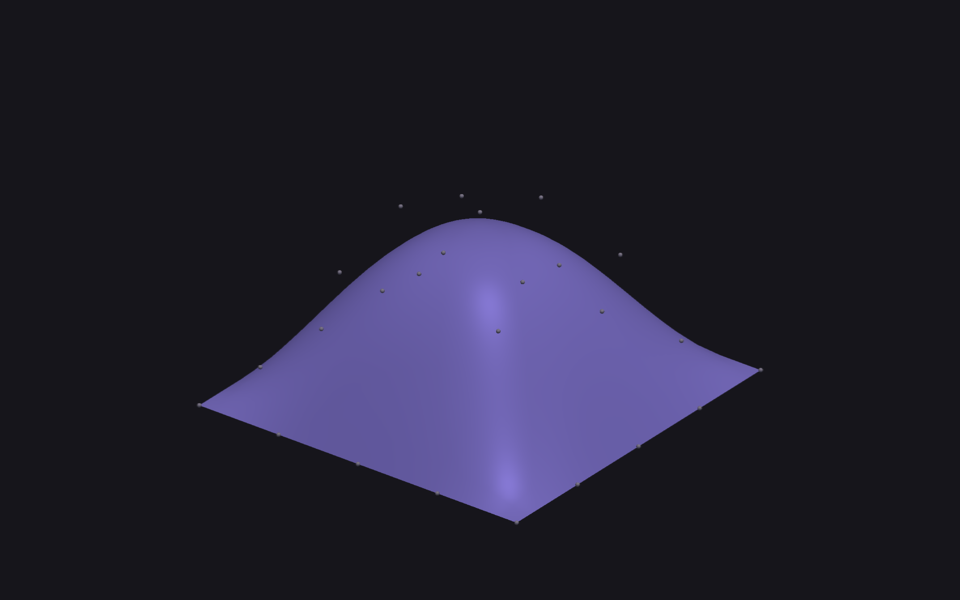
What for. Full control of a free surface: a grid of control points that pull it, for shells and free skins.
| Input | What it means |
|---|---|
| points | the control points, rows × columns |
| level u, level v | which levels are rows and columns |
| degree u, degree v | 1: facets · 2: curves · 3: smooth, up to 7 |
| weights | how much each point pulls |
| closed u, closed v | all the way round: a tube; in both, a torus |
Revolve
Section titled “Revolve”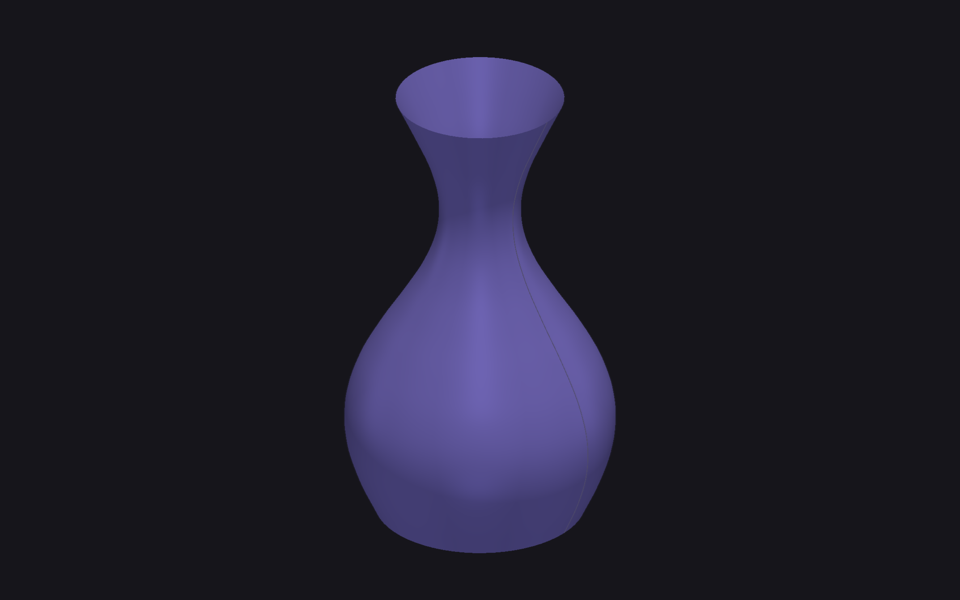
What for. A profile turning around an axis: a column, a dome, a vase, a tower.
| Input | What it means |
|---|---|
| profile | the half section that turns |
| origin, axis | a point on the axis and its direction (vertical by default) |
| degrees | how much it turns: 360 a full turn |
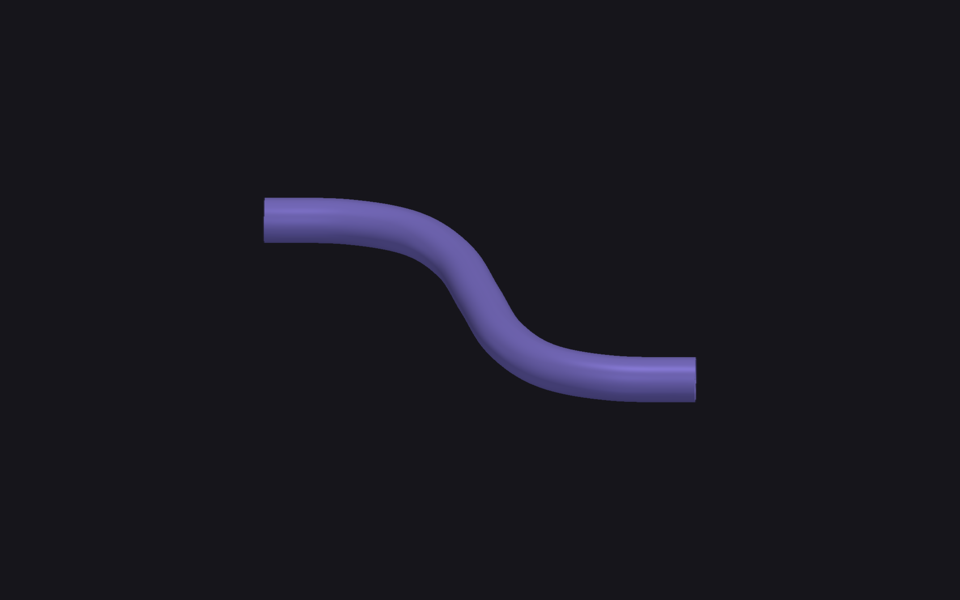
What for. A profile running along a path without twisting: a handrail, a moulding, a curved beam, a tube.
| Input | What it means |
|---|---|
| profile | the section that runs |
| path | the curve it runs along |
| path 2 | optional: a second path; the profile stretches to touch both |
| place | where it is (drawn at the start of the path) or centred on the path (drawn anywhere) |
| rotation | how many degrees it turns along the whole path |
Network surface
Section titled “Network surface”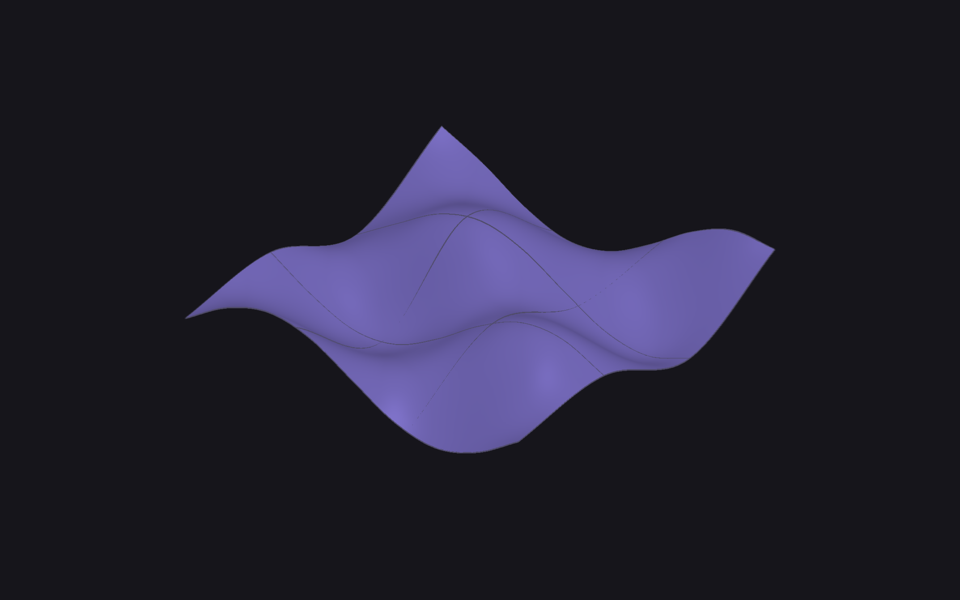
What for. A surface through a network of curves in two directions: the ribs of a hull or of a free roof.
How. Connect one family of curves to curves u and the other to curves v; each curve of one family must cross all those of the other.
Edge surface
Section titled “Edge surface”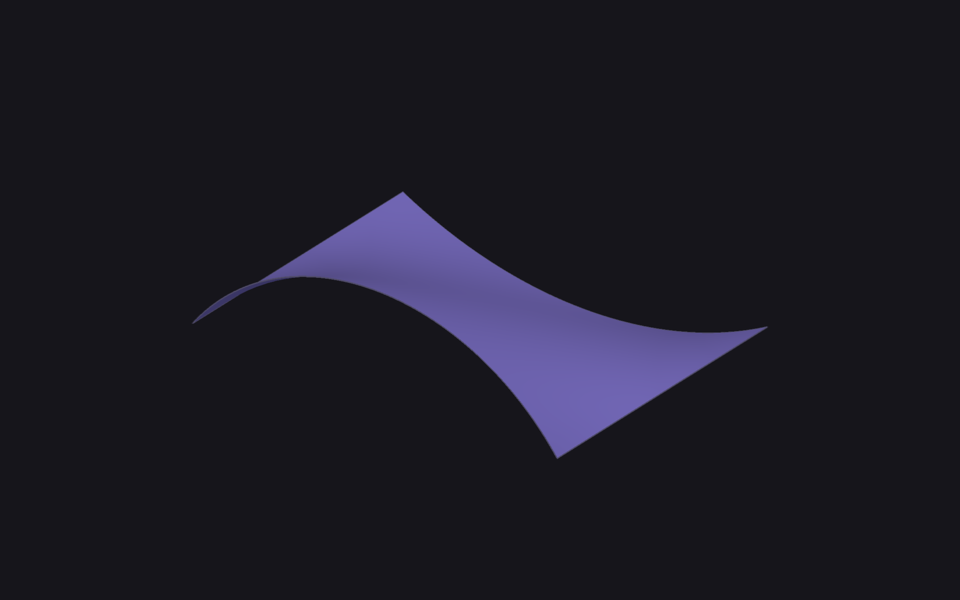
What for. A surface stretched between two, three or four edges that meet at the corners: a slab or a roof with curved edges.
How. Connect the edges to a, b, c and d, in any order. With two, a ruled surface; with three, one side closes into a point.
Work on a surface
Section titled “Work on a surface”Surface points
Section titled “Surface points”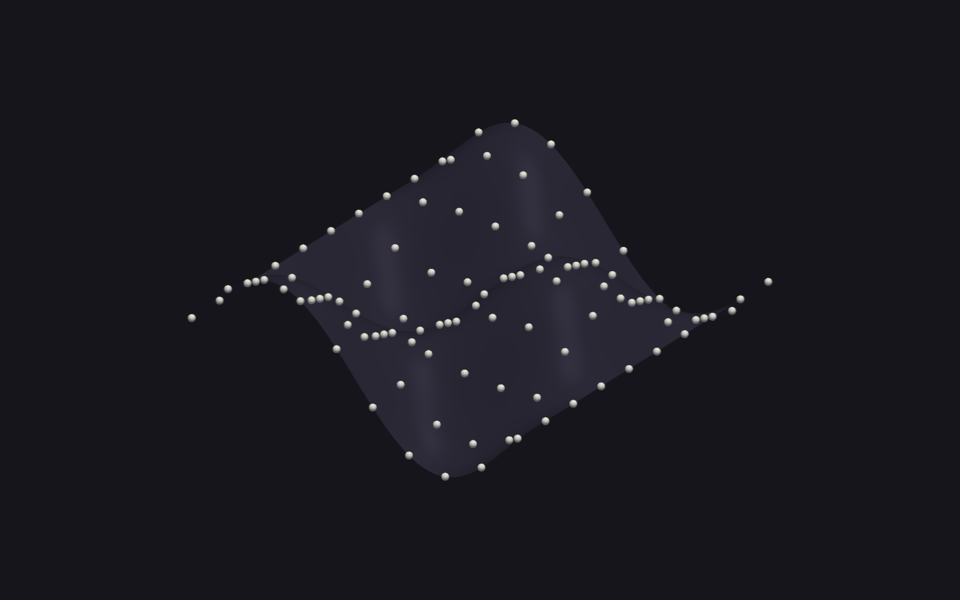
What for. Points on a surface, or the direction it faces there: to stand columns, anchors or pieces on it.
| Input | What it means |
|---|---|
| what | points or normals (where it faces) |
| mode | lattice: count u × count v from edge to edge · centres: the centre of each panel · fractions: at some u and v |
| count u, count v | how many along each direction |
| u, v | the fractions, several with ; |
Isocurves
Section titled “Isocurves”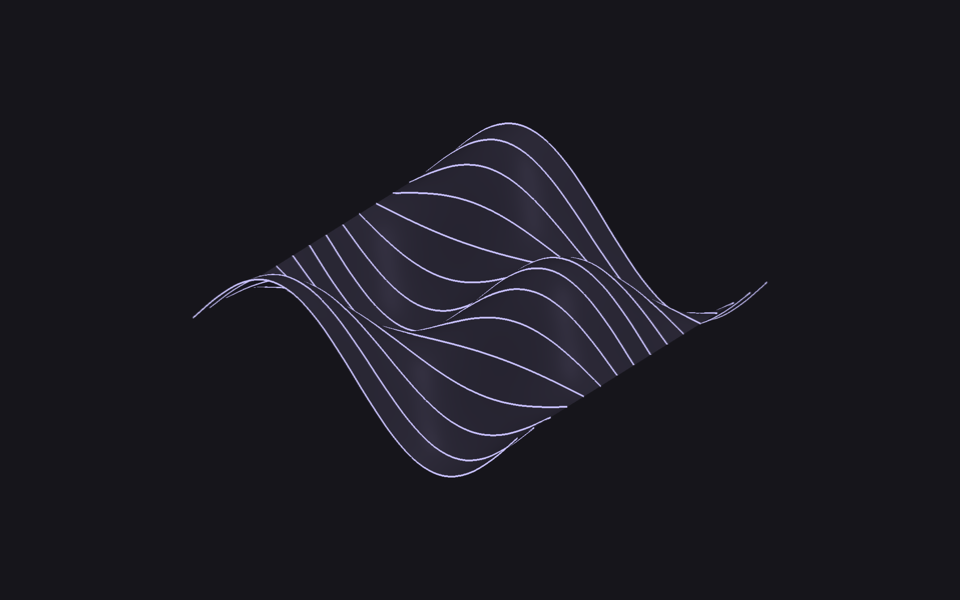
What for. The surface’s own lines, in u or in v: ribs, mullions, a layout that follows the shape.
| Input | What it means |
|---|---|
| direction | u or v |
| mode | parts (spread evenly) or fraction (at some positions) |
| count, positions | how many, or where |
Sub surface
Section titled “Sub surface”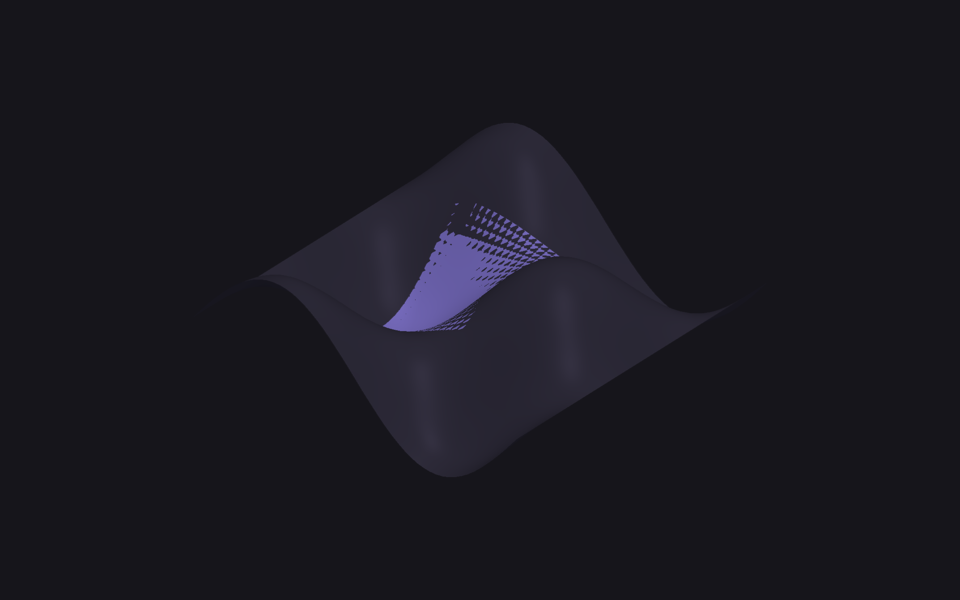
What for. The piece of a surface between two fractions of u and two of v: a bay of a roof, a segment of a dome.
Closest point on surface
Section titled “Closest point on surface”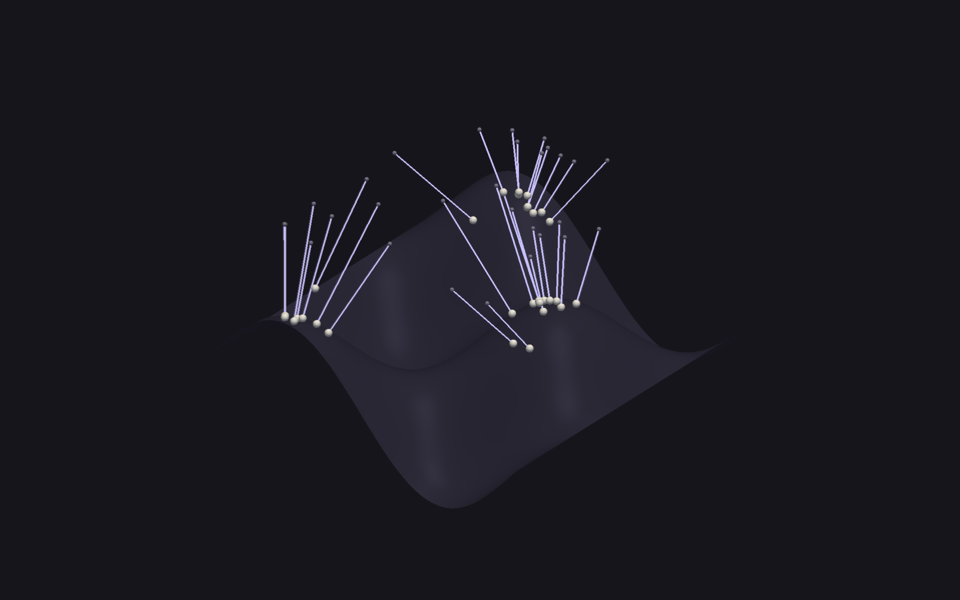
What for. The point of a surface closest to each point: to bring something onto it, or to know its u and v there, how far it is, or where the surface faces.
How. Connect the points and the surface, and choose what it gives: point, u v, distance or normal.
Curve on surface
Section titled “Curve on surface”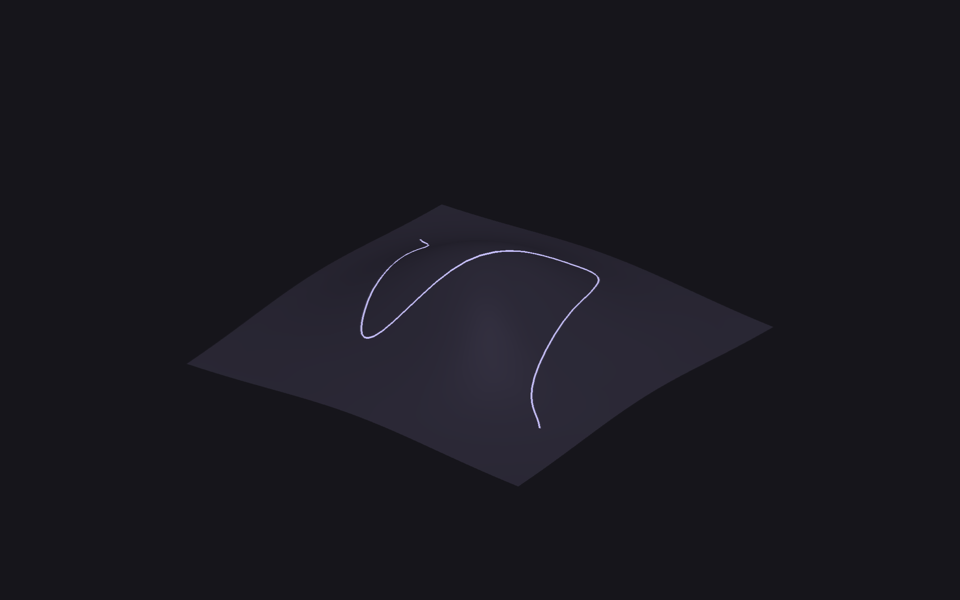
What for. A curve lying on a surface and following every bump: a path on a roof, a seam on a membrane.
How. Give points by their u and v, from Closest point on surface (u v) or with a Point where x is u and y is v.
Geodesic
Section titled “Geodesic”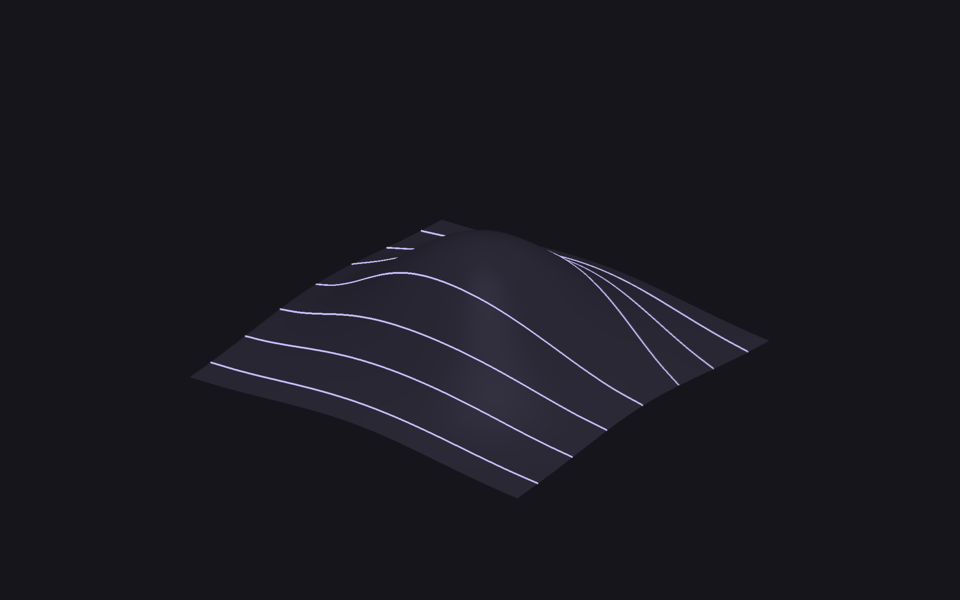
What for. The shortest path between two points over a surface, like a string pulled tight on it. Laths laid along geodesics stay straight in their own plane: that is why gridshells use them.
| Input | What it means |
|---|---|
| from, to | the start and end points, one end for each start |
| show | curves, their lengths, the crossings (the knots of a gridshell) or the bars between crossings |
Surface curvature
Section titled “Surface curvature”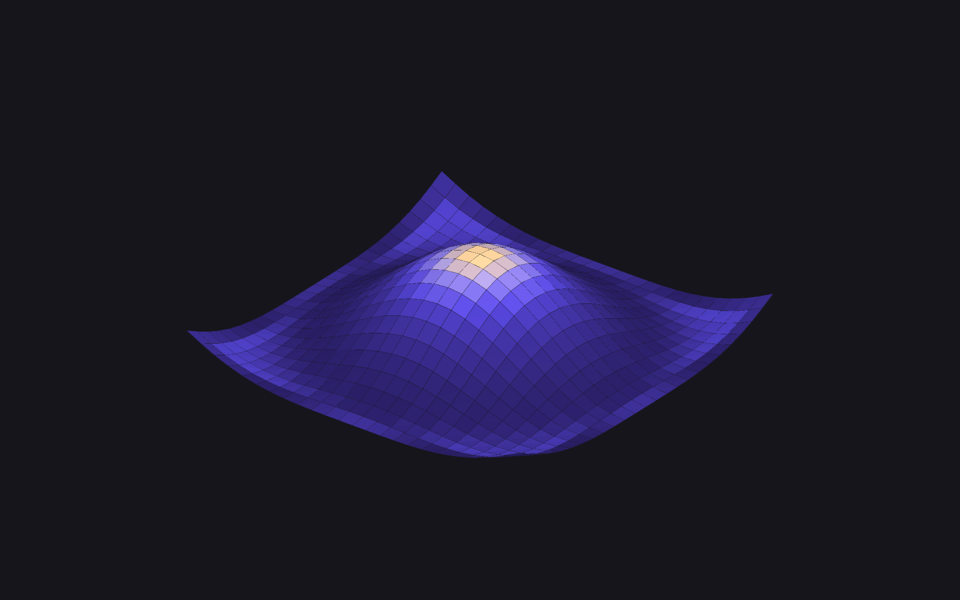
What for. To know whether a surface can be built from flat sheet, and how much it bends.
| Input | What it means |
|---|---|
| what | Gaussian: zero, made from flat sheet; positive, like a dome; negative, like a saddle · mean: how much it bends · developable: yes or no |
| mode, count, u, v | where, as in Surface points |
Tips.
- To see the curvature as colours on the surface, use the panel of the geometry (Colour → by a value).
Flip surface
Section titled “Flip surface”What for. To turn a surface the other way (its face), or to reverse or swap its u and v.
Tips.
- Thicken grows towards the face: flip it to grow the other way.
Intersection
Section titled “Intersection”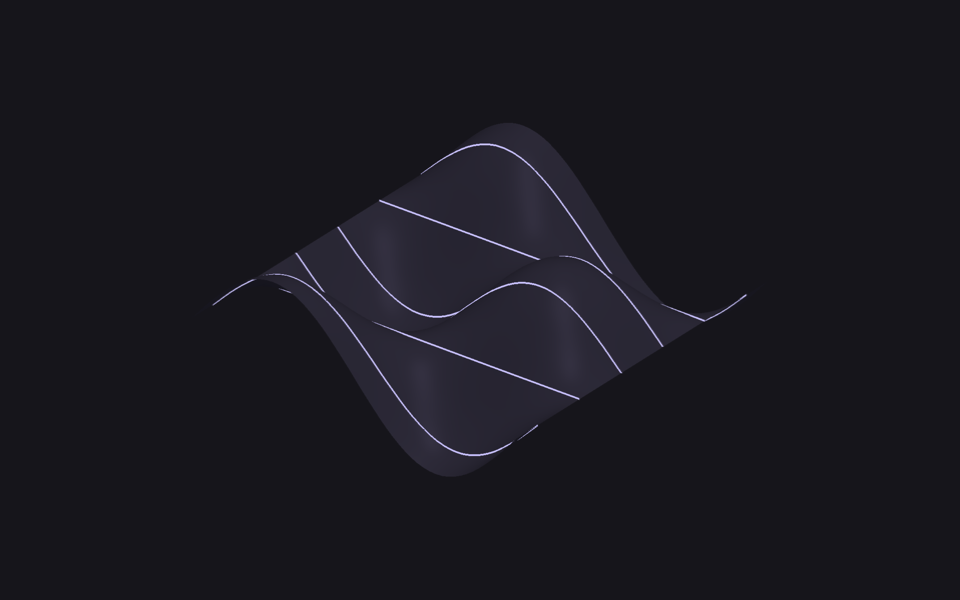
What for. Where two geometries cross: two surfaces give the crossing curves; a curve and a surface, the points.
Split surface
Section titled “Split surface”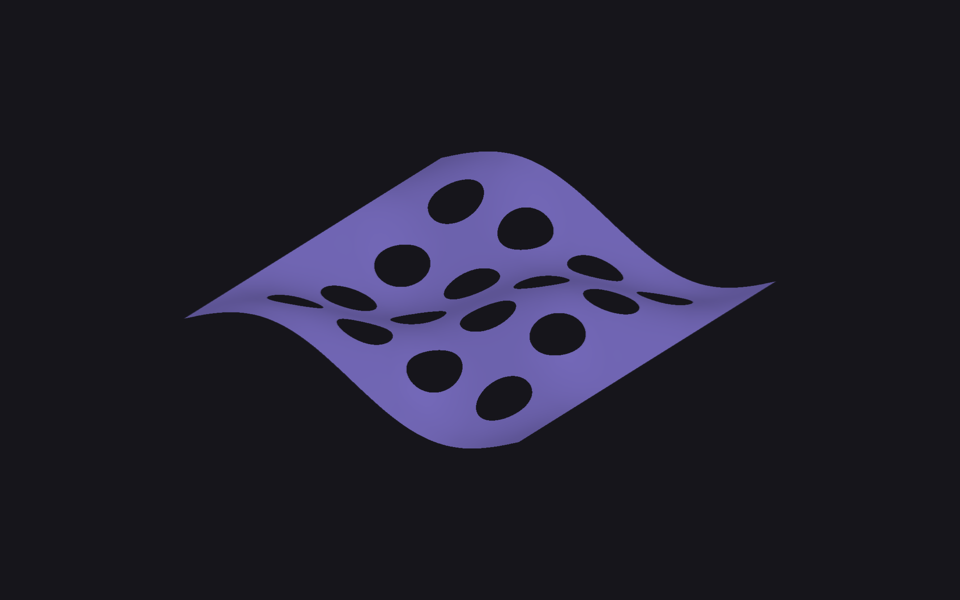
What for. A surface split into pieces by curves projected onto it: a perforated sheet and its offcuts.
| Input | What it means |
|---|---|
| curves | the curves that cut it, projected from direction (from above by default) |
| what | all pieces (largest first), the largest (the perforated sheet) or the others (the offcuts) |
Boolean
Section titled “Boolean”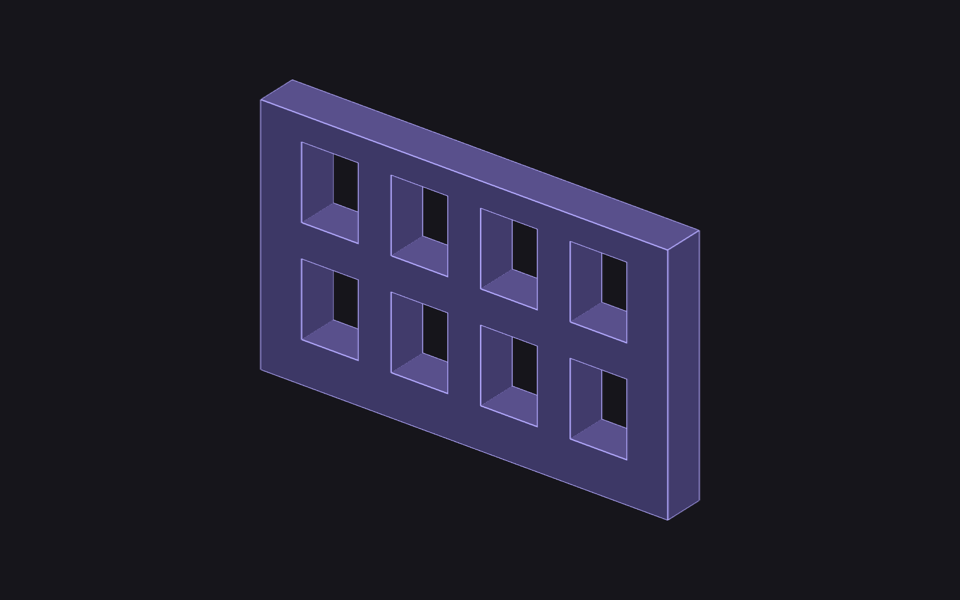
What for. To unite, subtract or intersect closed bodies: a wall minus its openings, two volumes in one skin.
| Input | What it means |
|---|---|
| a, b | closed bodies |
| operation | union, difference (a minus b) or intersection |
Unroll
Section titled “Unroll”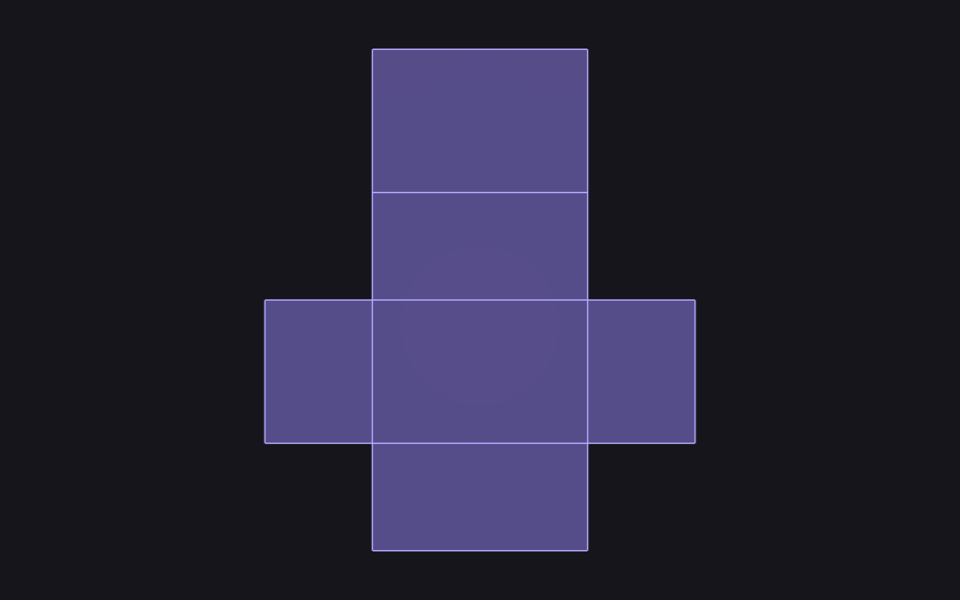
What for. To flatten surfaces to cut them from a sheet of metal, board or fabric. A body with flat faces gives its net, to cut and fold.
| Input | What it means |
|---|---|
| what | unrolled pieces, their outlines to cut, the folds of a net, or the stretch of a surface that is not developable |
| place | in a row or in place |
| spacing | between pieces |
Tips.
- A developable surface unrolls without stretching; one that is not, like a dome, unrolls approximately and says how much it stretches.
Structures on a surface
Section titled “Structures on a surface”Diagrid
Section titled “Diagrid”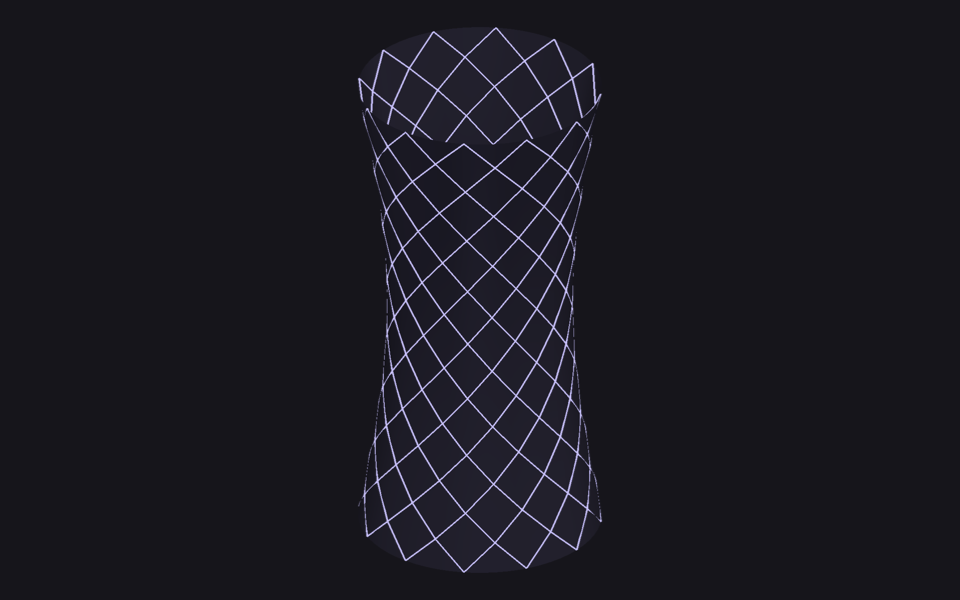
What for. A grid of diagonal members on a surface, in diamonds: a tower, a dome, a roof.
| Input | What it means |
|---|---|
| divisions u, divisions v | diamonds along each direction |
| what | the diagonals, the crossings (nodes) or the rings through the nodes |
| members | straight or curves following the surface |
| continuous | yes: each diagonal from end to end as one member (a helix on a tower) |
Tips.
- With Pipe on the diagonals, the structure; with Cap on the rings, the floor slabs.
Space frame
Section titled “Space frame”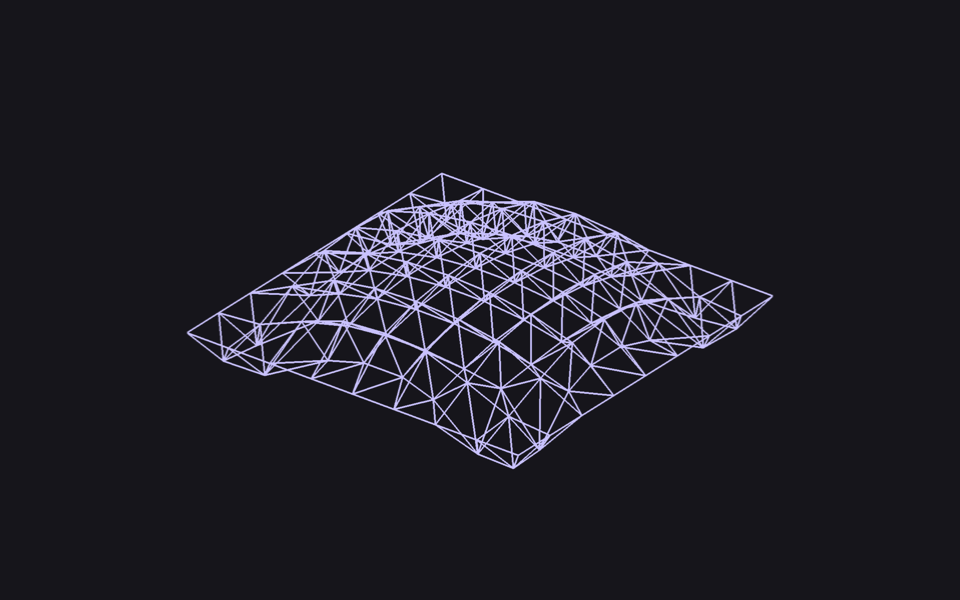
What for. A two-layer structure on a surface: the top chord on it, the bottom one shifted half a module and lowered, and diagonals joining them in pyramids.
| Input | What it means |
|---|---|
| divisions u, divisions v | modules along each direction |
| truss depth | the distance between the two chords |
| what | all members, one chord, the diagonals, or the crossings above or below |
Chebyshev net
Section titled “Chebyshev net”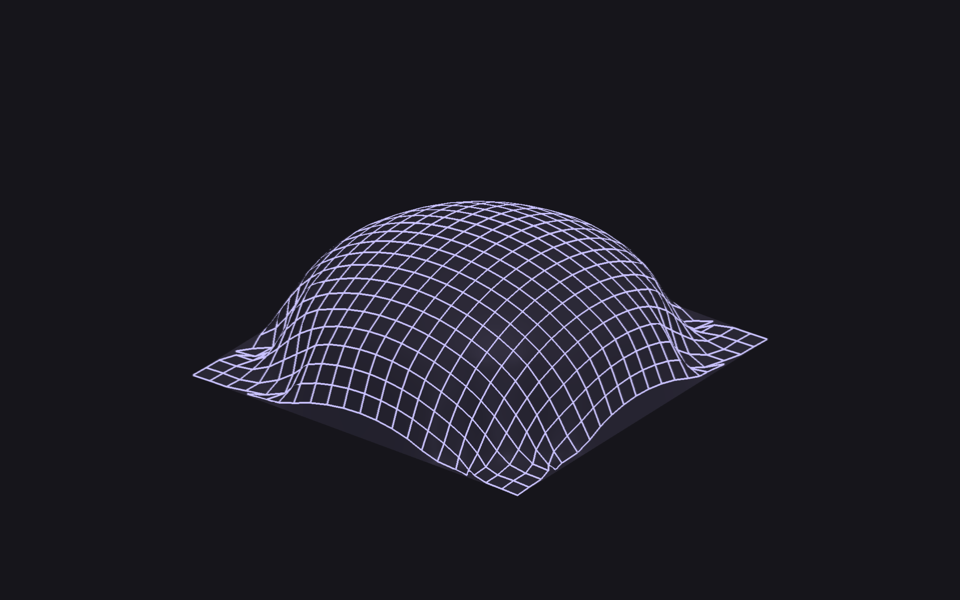
What for. The way a mesh of laths settles when bent, or a fabric when it drapes: quadrilaterals with four equal sides. For lath roofs and gridshells.
| Input | What it means |
|---|---|
| u, v | the starting point |
| step | the length of each side, between nodes |
| count | nodes on each side of the start |
| angle, rotation | the angle between the two starting laths, and their turn |
| what | all laths, one family, or the knots |
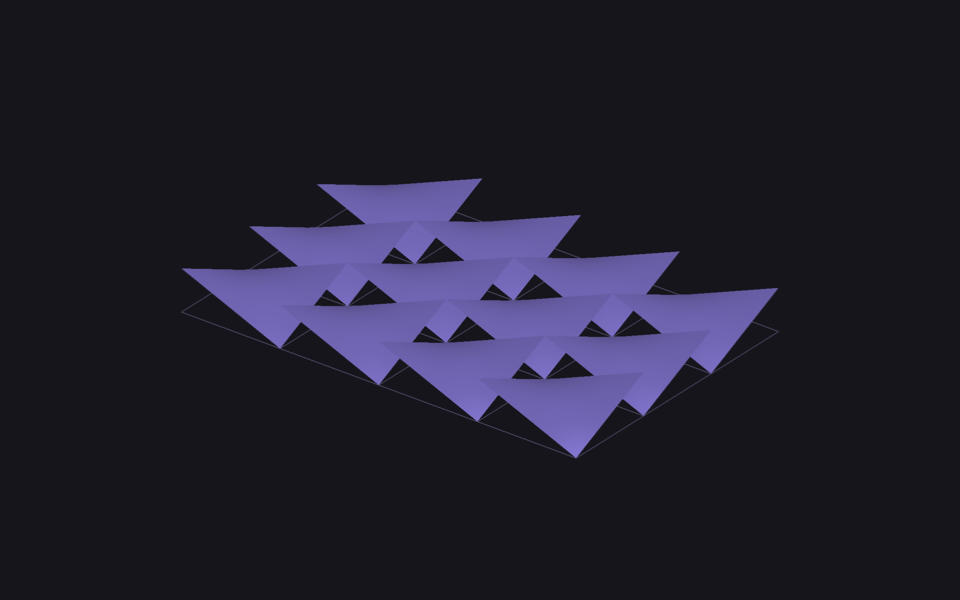
What for. To fold each panel into a hyperbolic paraboloid: two opposite corners rise and the panel becomes a saddle of straight lines, like paper folded along a diagonal.
| Input | What it means |
|---|---|
| panels | four-corner panels: a Grid, rectangles |
| lift | how much two opposite corners rise, in metres |
| corners | which two corners rise |
| show | the folded piece, the flat piece to cut, the fold or the longest edge |
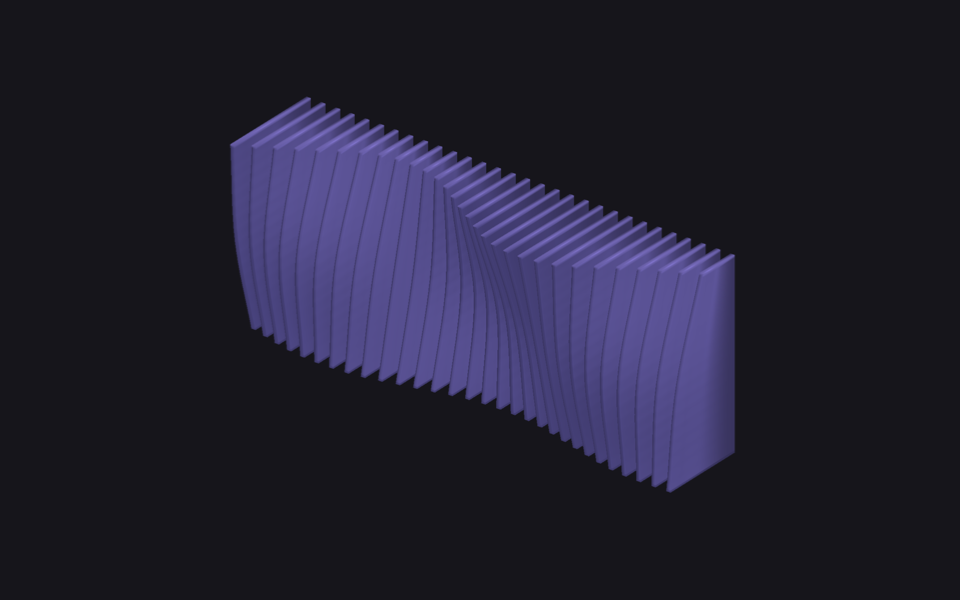
What for. To cut a shape into parallel boards closed against a wall: a rib wall, a slatted ceiling, a sliced bench. See Draw the form, then cut it.
| Input | What it means |
|---|---|
| shape | a surface, a mesh or a volume |
| count, weight | how many ribs, and their thickness |
| cuts | x, y: vertical ribs · z: horizontal slices |
| back | where the back wall is |
Surface morph
Section titled “Surface morph”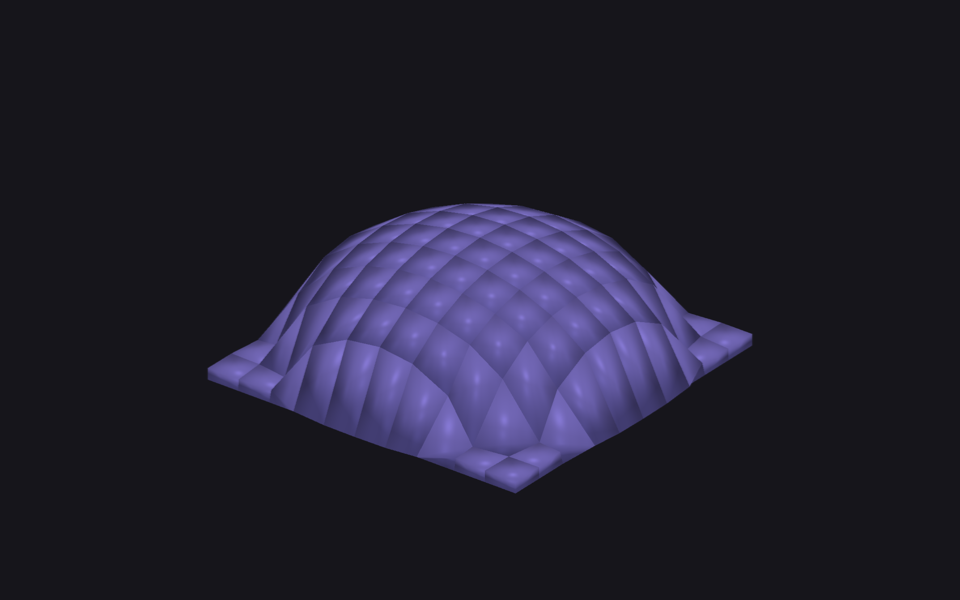
What for. To cover a surface with a module: the surface is divided into cells that follow its curve, and the module is fitted into each one, bending with it.
| Input | What it means |
|---|---|
| geometry | the module, drawn anywhere; empty: the cells themselves |
| count u, count v | cells along each direction |
| height | how far the top of the module rises from the surface |

What for. A member along each curve: round (railings, cables), rectangular (beams, mullions) or with a profile you draw (an I, an L).
| Input | What it means |
|---|---|
| section | round, rectangular or profile |
| radius, sides | for round sections |
| width, height | for rectangular ones |
| profile | a curve drawn around the origin, in plan |
| rotation, caps | turn the section; close the ends |
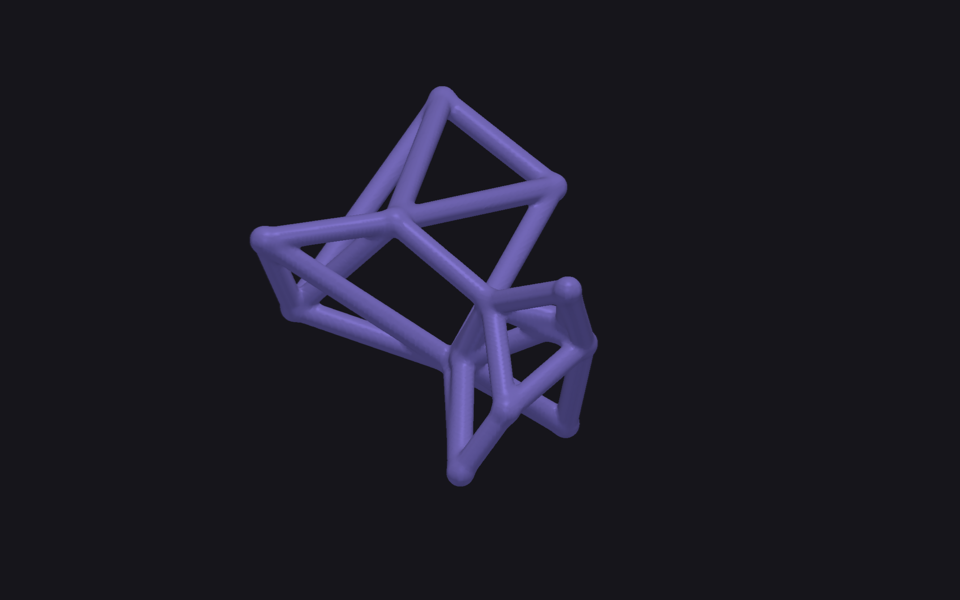
What for. A pipe around each line, all fused into one skin with smooth fillets at the nodes: a single sculptural structure.
| Input | What it means |
|---|---|
| radius | of the pipes |
| fillet | how much the nodes are filled; 0: none |
| detail | more is finer and slower |