Simulation
Simulation lets the forces draw the shape, or tells you how hard a structure works. These nodes are rose on the canvas. Forces are in newtons: 1 kg weighs about 10 N, 1 kN is 1000 N.
Equilibrium
Section titled “Equilibrium”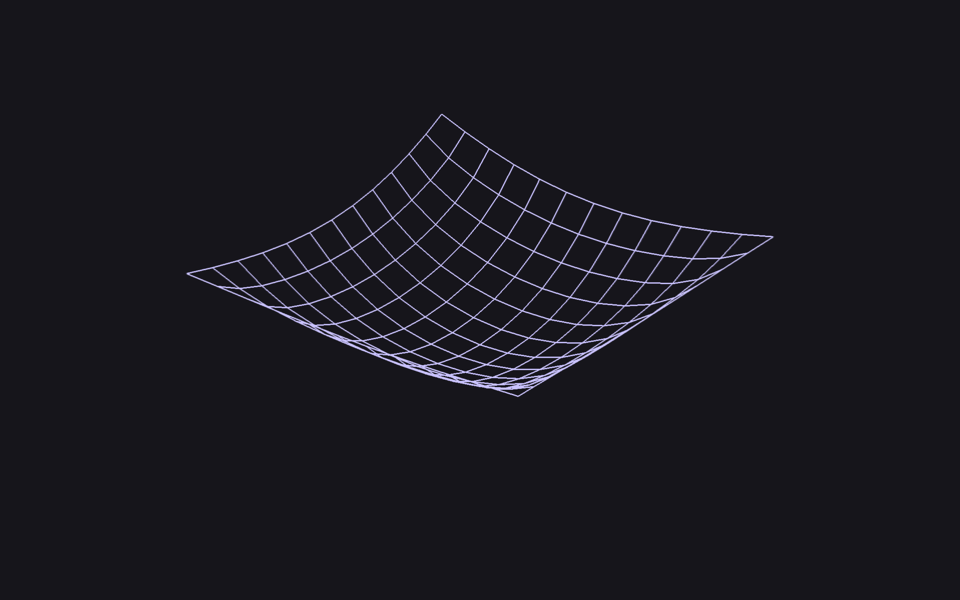
What for. The shape a cable, a net, a membrane or a shell takes at rest, hanging from its supports or lying on a floor, under its weight and its loads: the form finding of hanging models, cable nets, tensile fabrics, soap films and shells. Turned upside down, the vault that works mainly in compression.
How. Connect what hangs to shape: curves (cables) or a mesh (a membrane, from Mesh surface). It always gives the shape already at rest: change a support or a load and it hangs again.
| Input | What it means |
|---|---|
| shape | curves or lines (cables) or a mesh (a membrane) |
| spans | into how many spans each curve is divided; a mesh keeps its own |
| supports, more supports | ends or corners, the whole border, the start, or none; and points that also hold it |
| self weight | of all of it, in N |
| loads, load | points where a load hangs, and how much |
| stiffness | the force that would stretch it to twice its length: more, it stretches less |
| rest length | how long each span wants to be: 1 elastic, less pre-tensioned, 0 a soap film |
| diagonals | none, a cable net; one or both per square, a sheet that keeps its shape |
| bending | 0 a cable or a cloth; 0.001 rubber; 0.01 or more, a shell |
| floor | the height of a floor it rests on; with a floor it needs no supports |
| ties | lines whose ends are pulled together, as stitches (a gather, a pleat) |
| gravity | where the weight goes; upwards gives the shape that works in compression |
| moment | 1 at rest, 0 the start: the ▶ of the panel plays it |
| show | the shape, the spans, their elongation or their forces |
Tips.
- Supports can be moved by hand in the 3D view with Move supports: the shape follows.
- The forces are for finding the shape, not for sizing cables or membranes.
Bar analysis
Section titled “Bar analysis”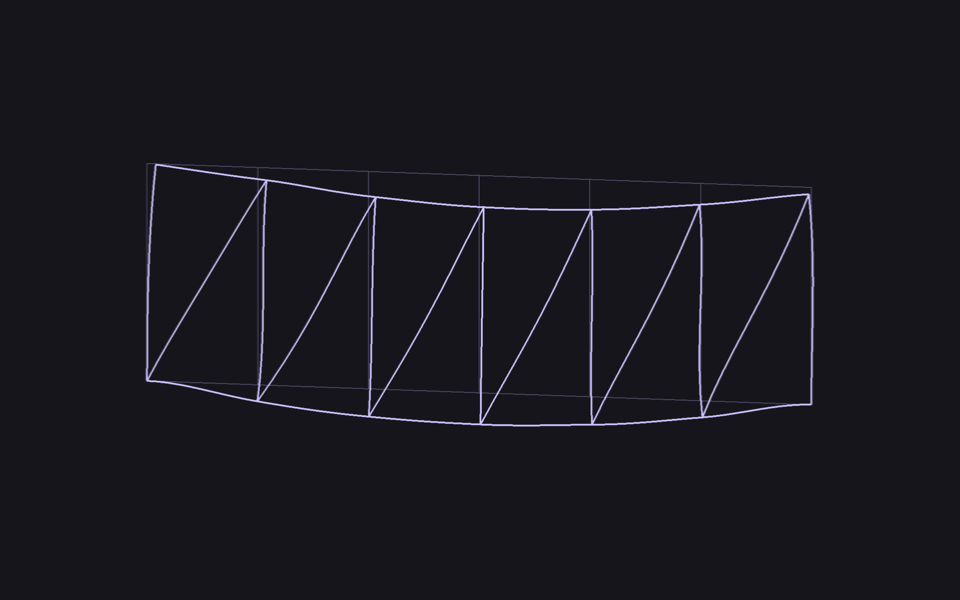
What for. How much a structure of bars bends and how hard each bar works: beams, columns, porticos, trusses, gridshells. A first sizing: it does not check buckling nor the joints, and applies no safety factors or building codes: an approximation for design, to be checked by a structural engineer.
| Input | What it means |
|---|---|
| shape | the bars: lines, curves or a mesh (each edge a bar) |
| diagonals | of each square of a mesh: none (a frame) or braced like a truss |
| supports, support | points held, and how: clamped, pinned or roller |
| loads, load, load per metre | point loads, and a load spread along every bar (a slab, snow) |
| self weight | add the weight of the bars |
| material | steel, timber, glulam, concrete or aluminium |
| section | IPE 300, HEA 200, rect 200x400, tube 200x100x8, pipe 168x8… in mm |
| show | the deformed shape, displacements, axial forces, moments, utilization, reactions, the largest of each, or the total weight |
Tips.
- Utilization above 1 (100 %) means the bar is too weak: a larger section, or more support. Below 1 is not a guarantee: it is a first check.
Topology optimization
Section titled “Topology optimization”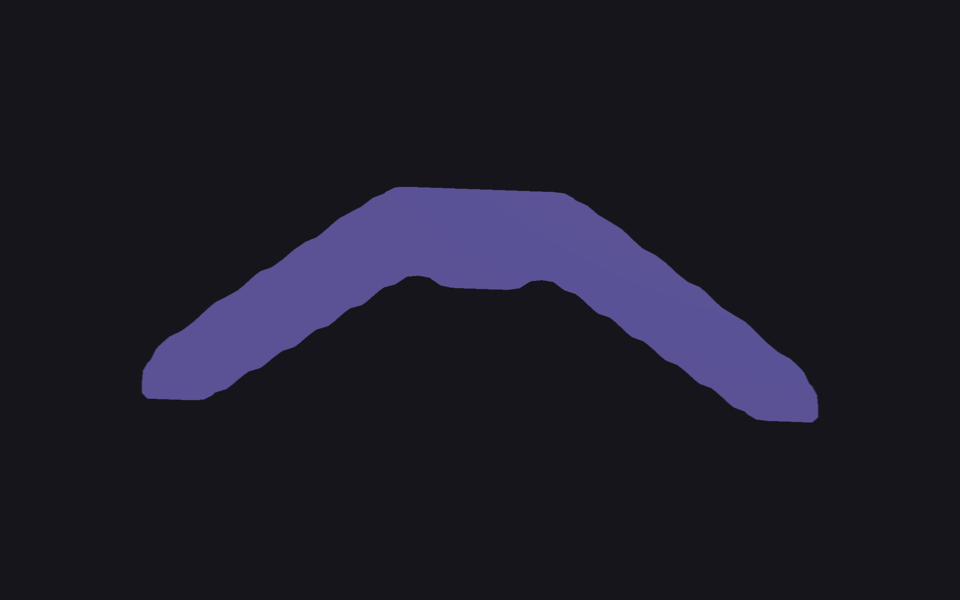
What for. Where the material should be, inside a region, to carry some loads to some supports with the least of it. It starts full and thin, and turn after turn the material goes where it works, until a structure is left: the arches and diagonals of a beam, the legs of a bridge. A form study: the result still has to be designed and checked as a structure.
| Input | What it means |
|---|---|
| region | where the material can go: an outline (2D) or a body (3D) |
| voids, solid parts | what must stay empty (a door) or full (a slab) |
| supports, rollers | points or outlines held in every direction, or only along the weight |
| loads, load | where a force is applied, and how much |
| density | how much of the region stays full: 0.3 leaves 30 % |
| resolution | cells along the longer side: more, finer and slower |
| show | the shape (outlines to extrude or cut), the plate, the cells, the density, the stress… |