
How Tensela thinks
Blocks of numbers
Section titled “Blocks of numbers”Inside Tensela, every value is a block of numbers: one number, a list, a table, or a block with more directions.
240 panels of a facade are a block row 12 × column 20; the corners of each panel add one more direction, corner 4; their coordinates, one more, x y z.
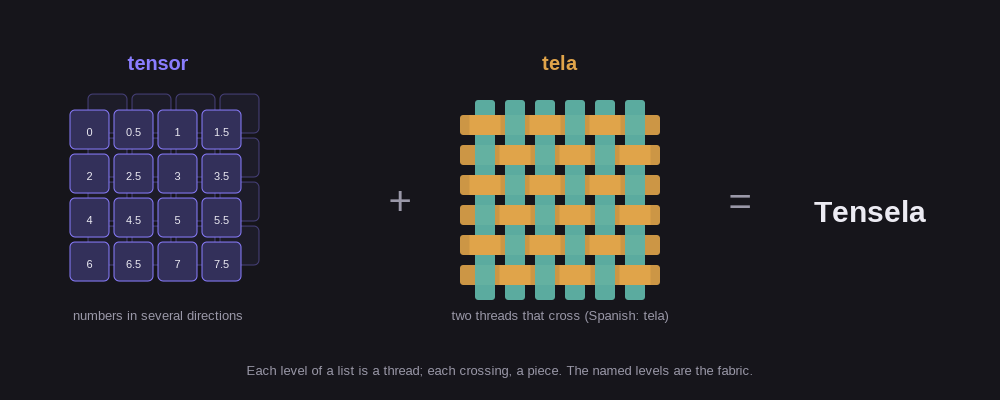
In mathematics, a block of numbers with several directions is called a tensor. That is the ten of Tensela.
Directions with names
Section titled “Directions with names”What makes Tensela different is that every direction of a block has a name: its level. Row, column, floor, rib. When a node combines two blocks, it lines them up by name:
- directions with the same name go one with one;
- directions with different names cross, every one with every other one.
The result has all the directions of both. That is the tela, the fabric, of Tensela: two lists are the warp and the weft, and every crossing is a piece. See Lists with names.
Why it is fast
Section titled “Why it is fast”A node does not go element by element: it computes the whole block at once. Moving 240 panels, or 24 000, is one operation on a block. This is why a facade of thousands of pieces can update while you drag a slider.
Why there is nothing to arrange
Section titled “Why there is nothing to arrange”Because directions have names and no order, row × column and column × row are the same block. There is no need
to transpose, flatten or graft lists before combining them: the names say how they go together. When two lists with
the same name have different sizes, a notice says so instead of guessing.
To go further
Section titled “To go further”- Named lists, inside: the rule in code, levels of variable size and holes.
- How a project is calculated: what is recalculated when you change something.
- Lists in Tensela, Grasshopper and Dynamo: the same tasks in the three tools.